
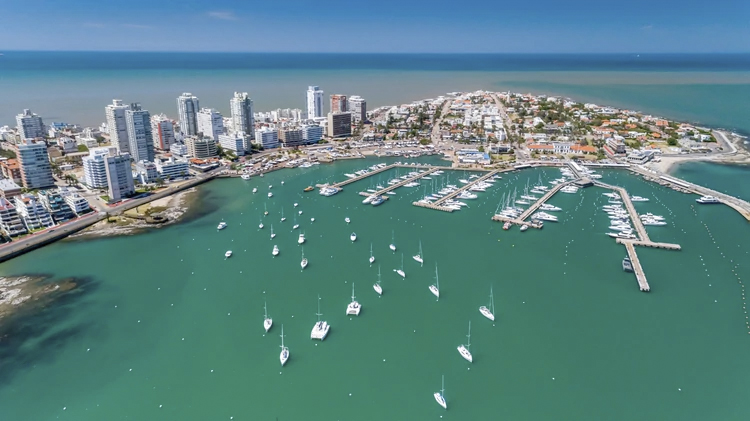
The real estate boom in Punta del Este shows no sign of slowing, and the city is one of the central hubs of investment in the region
Over the last four years, USD 4,500 million has been poured into construction, 70% of it from Argentine developers and owners
In 2019, revenue from the property transfer tax barely reached two thirds of the volume recorded in 2011, the weakest performance of the decade for the sector, as measured by revenue from that tax. However, for Cr. Daniel Porcaro, Academic Director of the Diploma in Real Estate Business at Universidad ORT and Partner at Porcaro Consultores, investing in property remains a good store of value. He believes there are factors encouraging a reversal of the trend of recent years, but considers it unlikely to happen in 2020. Porcaro stated that the role of a city's local authority is key to increasing the real estate value of that metropolis, taking into account the Smart City Index. Below is a summary of the interview.
-How do you assess the dynamism of the real estate market in 2019?
-As expected, 2019 was not a good year for the dynamism of the real estate market. If we measure it through the annual change in ITP (property transfer tax) revenue expressed in UI, we can conclude it was the worst year of the last ten. Considering that the highest revenue from this tax in the last decade was in 2011 and that 2019 represents two thirds of that volume, and that revenue has been falling steadily since 2012, the result is that we closed a bad year and a worrying trend.
-What explains this result?
-Property prices have not fallen, so the explanation must be found in the causes behind an ever-smaller volume of transactions due to a lack of market vigor. The average value of a two-bedroom apartment in Montevideo has grown 21% in real terms over the last ten years; in Pocitos the value grew 17% and in Cordón it rose 23%. The average annual appreciation for this type of housing is approximately 2.5% in real terms, which shows that investing in property remains a good store of value. What happens is that current and near-term dynamism is shaped by past expectations. The election year and the uncertainty it brought, together with a complicated regional and global context and the rise of the dollar, explain a good part of last year's poor performance. Every time the dollar jumps, or is simply expected to, ITP revenue drops between 16% (when the dollar went from $ 28 to 38 per dollar) and 12.5% (when it went from $ 20 to $ 28 per dollar), which means a lower volume of transactions, as we saw before.
-Did this reality affect those looking for a home to live in as much as those investing in this market?
-If you look at the existing submarkets, you can see that end-user homebuyers were affected by weaker domestic activity, higher unemployment and reduced chances of getting a mortgage. At the same time, the investor market was affected by a preference for keeping liquidity in the face of possible market price adjustments or tax measures from the new government that could affect real estate investment.
-Could this trend deepen or reverse this year?
-I believe there are factors that encourage a reversal of the trend of recent years, but I doubt it can happen during 2020. The first essential step in that direction is a change in the expectations of the different players. With the uncertainty over the new government cleared up, it is reasonable to expect continued support for the sector and no additional tax burden on real estate investors. Even the signals of continued support for Vivienda Promovida housing and of removing some existing obstacles seem to encourage developers and reassure investors. Second, the fundamentals of real estate profitability need to be rebuilt. The expectation of returns is essential for investors, and the sector has lost profitability, or has maintained or improved it only thanks to tax efforts. Profitability is calculated by comparing rental income, net of expenses and taxes, to the market price of the properties. The Vivienda Promovida Law achieved its goals: it brought a significant number of homes to neighborhoods that needed their housing stock renewed, lowered rental prices thanks to greater supply, and delivered reasonable rates of return for investors. The issue is that investments in non-promoted areas are showing profitability problems because of the higher price per square meter, the tax burden on the investment, and a rental price differential that fails to keep pace with those factors. Put simply, the gross yield of a real estate investment in a promoted apartment in Cordón can reach 6% per year, while in Pocitos it does not reach 4%.
Third, the purchasing power of end consumers in real estate needs to be restored, or the number of consumers and investors in the sector needs to grow, which depends on exogenous variables and long-term policies.
-And what can we expect in the short term?
-We could see a new surge in the value of the dollar as a result of the situation in Argentina and Brazil, along with an increase in international interest rates. That could prolong or deepen the stagnation if property prices in dollars do not come down. If that does not happen, and the Uruguayan economy stabilizes or shows signs of at least a slow recovery, in line with fragile global growth expectations, consumer and investor confidence will slowly strengthen and the market will pick up again, first absorbing the existing stock of new homes and then with greater investment in new developments.
-Considering the structural conditions of the local market, how can this picture be reversed in the long term?
-The sector's short-term dynamism is shaped by the variables we mentioned, but future growth and opportunities depend on the work done on strategic variables that improve real estate value. We are constrained by having a small market, which means a less liquid and riskier market, with a slower turnover of existing homes.
This context is nothing new: there are small cities that improve the value of their real estate assets and act strategically to do so. Attracting foreigners to Uruguay by offering incentives to settle here is a good idea; every country does it, especially in Europe. The goal is to create a demand shock that complements the effort made to boost supply, as was done with the Vivienda Promovida Law. To attract more residents, cities work on concrete goals that improve their performance relative to others, evaluating and working on the six dimensions of the Smart City Index (SCI). The modern view of a mayor, or of any regional authority, is to make their city, neighborhood or territory improve in value and quality of life, and that is measured through the SCI.
New York is the city with the best SCI in the world and London the best in Europe. A study by CBRE (Coldwell Banker Richard Ellis, the world's largest commercial real estate services firm) states that a 10% increase in a city's SCI raises the performance of its real estate market by 8.2% on average, measured by investment volume and the rents and prices of real estate assets. That is how city administrators add value to their work. It would be truly transformative if mayoral candidates made management proposals based on how to improve Montevideo's SCI, because it would be a qualitative shift in how we think about municipal management, giving it an international standard and, above all, making it possible to objectively measure mayors' performance. At first glance, Montevideo shows very solid indicators compared with other cities in the region, but the areas that need work also stand out clearly.
-Is it possible to think about attracting foreign residents? Let's recall the reference in January to the thousands of Argentines the country hopes to attract…
-Honestly, I don't know what the figure is based on when they spoke of 100 thousand Argentines. We don't necessarily have to be attractive only to Argentines. Keep in mind that property values in Recoleta, Barrio Norte and Palermo are around US$ 3,200 per square meter, the same as similar neighborhoods in Montevideo such as Pocitos and Punta Carretas, so it is unlikely that they would come because the cost of living or property is cheaper; they would come here if they find a better city, with a better quality of life and coexistence than in Buenos Aires. If we manage to attract more residents, even in smaller numbers than announced, we would be on the same growth path as the world's leading cities.